Three ways to stay connected abroad. Each is genuinely better than the others at something, and none of them is right for every trip.
There are three realistic ways to have working data on your phone in another country. Your own network can carry you there. You can rent a small box that makes its own Wi-Fi. Or you can add a second, temporary line to your phone before you go.
Most comparisons of these three are written by someone selling one of them. This one is too, so here is the useful version: we will say plainly what each is good at, including the parts where the other two win.
What actually happens when you land
Your phone looks for a network it is allowed to use. If your home network has an agreement with a local one, and your plan permits it, you connect and your home network bills you for that under whatever roaming terms you agreed to. If not, you see a signal bar and no data, which is the moment most people notice they should have thought about this.
All three options below are different answers to that same moment.
Option one: your own network’s roaming
The simplest thing to do is nothing at all. Your existing number keeps working, calls and texts behave normally, and there is nothing to set up.
Where it works well: short trips inside whatever region your plan already covers, and any situation where you need your own number to receive calls or verification codes reliably.
Where it goes wrong: outside that included region, the daily rate or the per-megabyte rate applies, and both add up faster than people expect on a two-week trip. Some plans charge a flat daily fee for access, which is fine for one or two days and expensive across a fortnight. It is worth reading what your own plan actually says before you assume either way.
Option two: a pocket Wi-Fi device
A small rented box with its own data connection, which makes a private Wi-Fi network for whatever you connect to it.
Where it works well: groups and families. One device can serve several phones, a laptop and a tablet at once, which makes the per-person cost fall the more people share it. It also works with any device, including older phones that cannot take a second line.
Where it goes wrong: it is another object. It needs charging, it needs carrying, it needs collecting and returning, and it only helps the people standing near it. If your group splits up for the day, one person has the internet and the others do not.
Option three: a travel eSIM
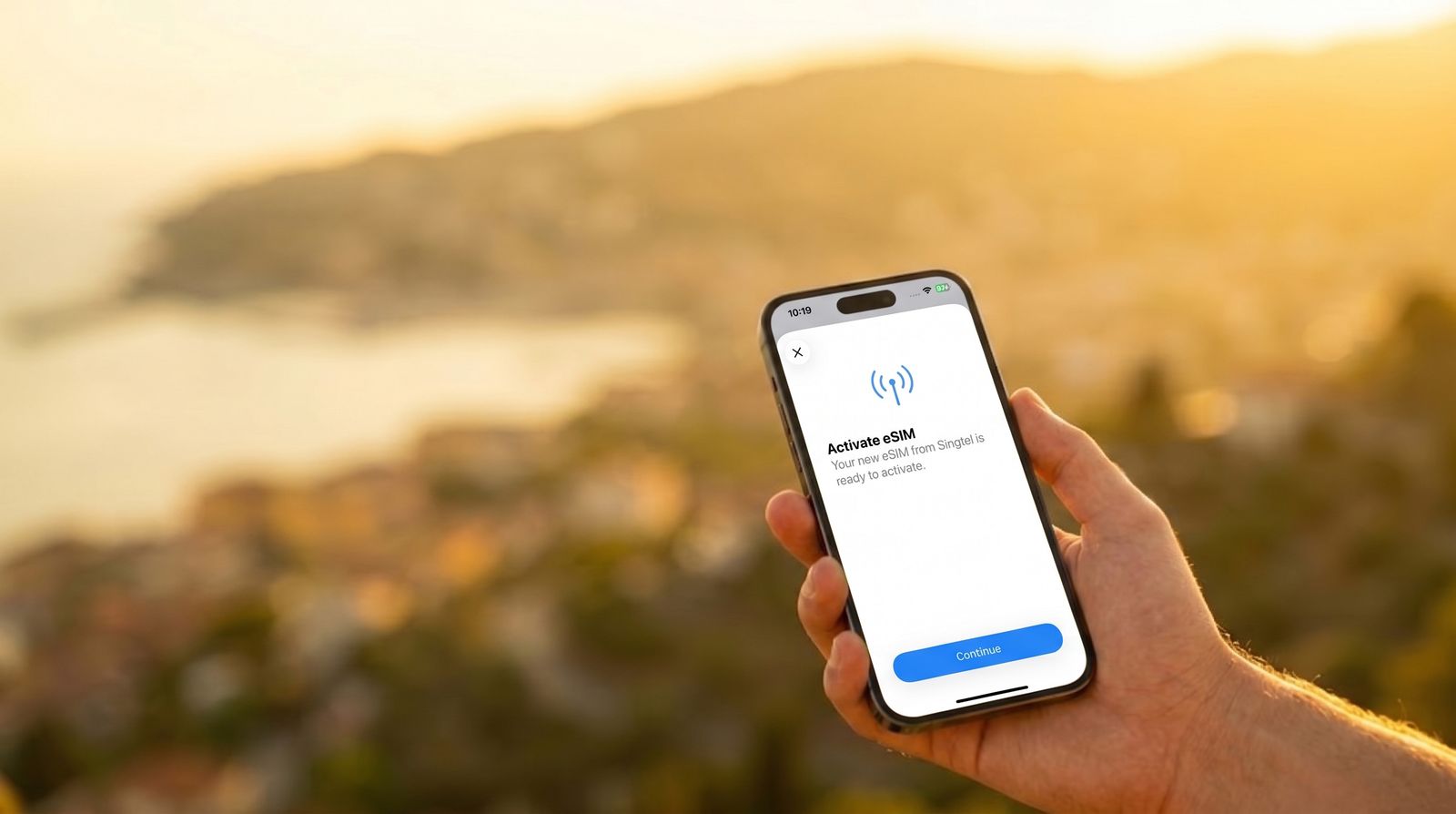
A second line added to your phone electronically, which you set up before you leave and which carries your data while you are away. Your usual number stays on the phone for calls and texts.
Where it works well: solo travellers and couples, trips of a few days to a few months, and anyone who would rather not carry another device. You set it up at home on your own Wi-Fi, and it starts working when you arrive.
Where it goes wrong: your phone has to support it, which most phones sold in the last several years do but not all, and a phone locked to a contract may refuse. It is also data only. If someone needs to ring your usual number, that still comes through your own line under your own network’s terms.
What each costs in practice
Costs move, so treat any figure you read anywhere, including here, as dated. The shape of the costs, though, is stable:
Roaming tends to be charged either as a daily access fee or per unit of data. Daily fees are predictable and get expensive over long trips. Per-unit charges are cheap if you barely use anything and alarming if you stream.
Pocket Wi-Fi is charged per day of rental, usually with a data allowance, plus a deposit and sometimes a delivery or collection charge. The daily rate is the number to compare, not the headline.
A travel eSIM is charged once for a bundle of data over a set period. What you pay is what you pay, and it does not change based on how much you use.
The comparison that matters is not which is cheapest per gigabyte in the abstract, but which is cheapest for the trip you are actually taking. A group of four on a week’s holiday and a solo traveller working abroad for two months are not answering the same question.
Which one suits which trip
A weekend somewhere your plan already includes: do nothing. Roaming is genuinely the right answer and anything else is effort for no gain.
A family of four, one hotel, mostly together: a pocket Wi-Fi device is often the sensible choice, especially with tablets and a laptop in the mix.
One or two people, a week or more, outside your included region: a travel eSIM usually costs less and is less to think about.
A long stay or remote work: a larger eSIM bundle over a longer window, which is where the per-gigabyte cost falls furthest.
A phone that cannot take a second line: pocket Wi-Fi, or roaming. This is worth checking before you buy anything — there is a short guide to that check on this blog.
The honest summary
If you are going somewhere your existing plan covers properly, use it. If you are travelling as a group with several devices, rent the box. If you are one or two people going somewhere your plan does not cover well, a travel eSIM is usually the least expensive and the least to carry.
We sell the third one. We would rather you used the right one.