This article recommends nothing and sells nothing. It is an attempt to explain a confusing category properly, because someone should.
There is a great deal written about eSIMs and most of it is written to sell one. That makes it hard to find a straight answer to a simple question: what is this thing, and where does it fit alongside everything else that already gets you online.
So: no plan recommendations here, no comparison tables, nothing to click at the end. Just the explanation.
What an eSIM actually is
A SIM card does one job: it tells a mobile network who you are, so the network knows whether to let you connect and who to bill. Everything else about the card — the plastic, the gold contacts, the tiny tray and the paperclip — is just packaging for that one piece of information.
An eSIM is the same information, stored in a chip already built into the phone rather than on a card you insert. That is genuinely the whole idea. The "e" is for embedded, and it describes where the thing lives rather than what it does.
Because it is software rather than plastic, a phone can hold several at once and switch between them, which is where the useful part comes from.
The four ways people get online away from home
Wi-Fi
Someone else’s fixed internet connection, shared wirelessly. Hotels, cafés, airports, the apartment you rented.
Good at: volume. It is usually the fastest thing available and it costs nothing at the point of use, so it is the right place to do anything heavy — backing up photographs, downloading things, video calls where you are sitting still.
Bad at: being there. It exists in specific places and nowhere in between, and its quality varies from excellent to unusable with no way to tell in advance.
A physical SIM from a local network
Bought on arrival, inserted in place of your usual card.
Good at: price and local integration. A local prepaid SIM is often the cheapest data available in a country, and it gives you a local number, which matters for things like local delivery apps and taxi bookings.
Bad at: everything around it. You have to find a shop, sometimes register with a passport, and physically remove your own SIM — which means your usual number stops working, and the tiny card ends up in a hotel drawer. It is also useless for the first few hours after you land, which are often the hours you most need to be online.
A pocket router
A small rented box with its own mobile connection, broadcasting a private Wi-Fi network.
Good at: groups and non-phone devices. One box serves several phones, a laptop and a tablet at once, and it works with any device including ones too old to take a second line.
Bad at: being an object. It needs charging, carrying, collecting and returning, and it only helps whoever is standing near it. Split the group and one person has the internet.
An eSIM
A second line added to the phone electronically, usually set up before you travel.
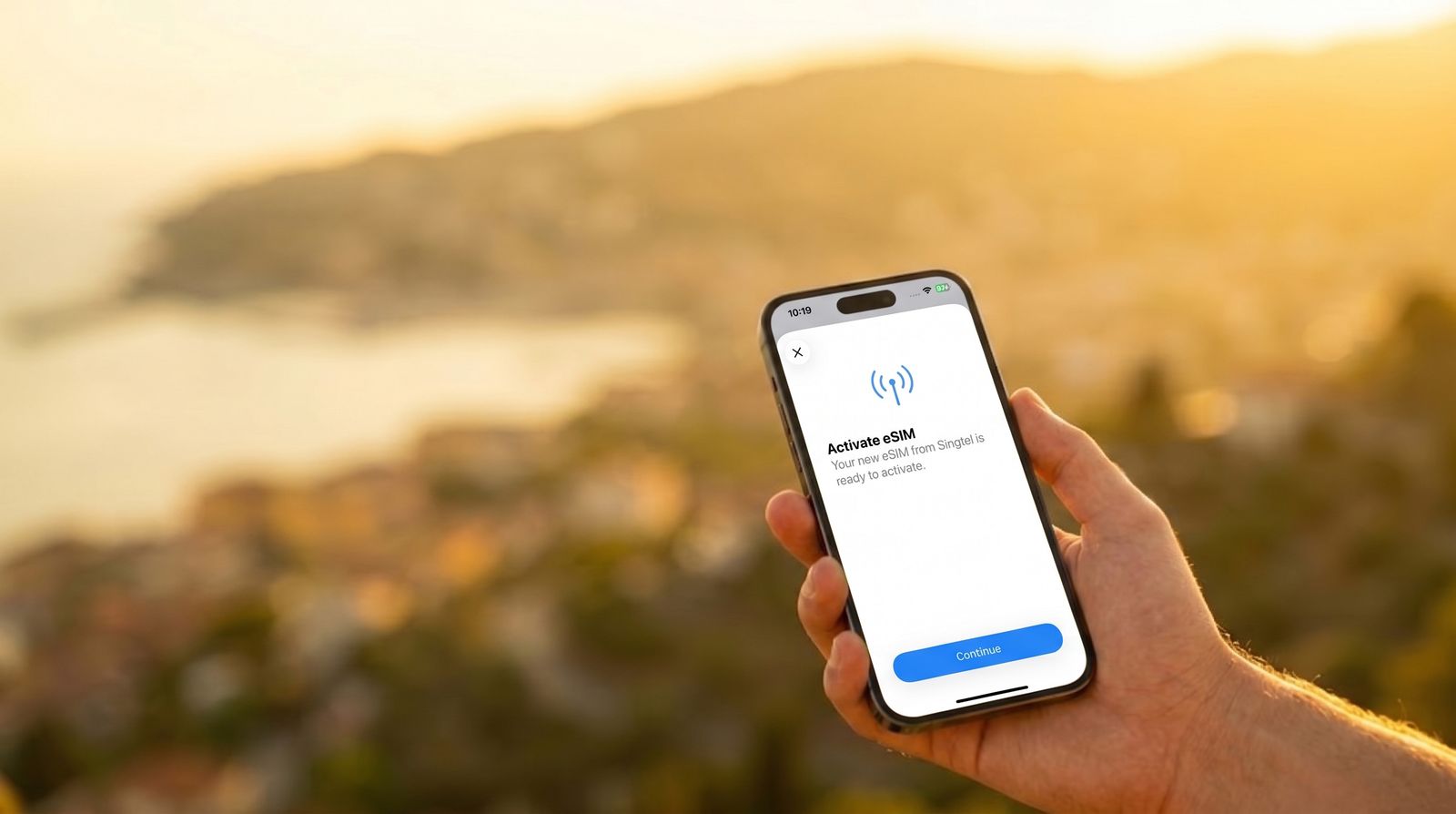
Good at: continuity and being ready. Nothing to buy on arrival, nothing to swap, and your usual number stays on the phone. It works from the moment you land.
Bad at: the device requirement. Not every phone supports it, contract-locked phones may refuse, and it does nothing for a laptop unless you tether. It is also data only — it does not give you a local phone number.
THE HONEST SUMMARY OF ALL FOUR
Wi-Fi is for volume. A local SIM is for price and a local number. A pocket router is for groups and multiple devices. An eSIM is for continuity and arrival.
None of these replaces the others, and the sensible traveller uses two or three of them without thinking about it — Wi-Fi at the hotel, something mobile in between.
Where they complement each other
The combinations are more interesting than the comparisons.
Wi-Fi plus a mobile line is the standard arrangement, and the allocation matters: heavy things on Wi-Fi, time-sensitive things on mobile. A video call that must not drop is better on mobile than on hotel Wi-Fi shared with two hundred other rooms.
A pocket router plus phones works for a family that stays together and falls apart the moment they do not. Many groups end up with both — the router for the apartment, a line on one phone for the day.
A local SIM plus your own number is impossible on a single-SIM phone and easy on a dual-SIM one. This is the arrangement long-stay travellers usually settle into.
Two eSIMs is increasingly common for people who move between countries regularly: keep one for the region you visit most, add another as needed, switch without touching anything physical.
Three situations where an eSIM is genuinely the right answer
Not because it is better in general, but because these are the specific shapes of problem it fits.
The two hours after you land
You are tired, you need a taxi or a train, and the thing you need most is a working connection. A local SIM requires a shop; Wi-Fi requires finding one that works. A line set up at home before you left is already working when the plane doors open. This is the clearest case.
Short hops between countries
A trip crossing three borders in a week makes local SIMs impractical and roaming expensive. A regional line, or several stored lines switched as you go, handles it without any physical faff.
Keeping your own number reachable
If your bank sends codes to your usual number, or work needs to reach you on it, removing your SIM is a real problem. A second line lets data be cheap without your identity going offline. This is the underrated one.
Where it is heading
Two developments are worth watching, and both are honest speculation rather than promises.
Devices are dropping the card slot. Some phones are already sold without one in certain markets. As that spreads, the choice between physical and embedded stops being a choice, and the interesting question becomes how easy it is to move a line between devices — which is currently harder than it should be.
Direct-to-device satellite connectivity is arriving. Ordinary phones are beginning to connect to satellites for basic messaging in places with no mast for a hundred miles. It will not replace mobile networks for data any time soon — the capacity is not there — but it changes what "no signal" means, particularly for the mountain, maritime and remote-area situations where nothing currently works.
Neither of these makes anything on this page obsolete. They add options, which is broadly what the last twenty years of this category has done.
How to decide, without anyone selling you anything
Check whether your phone supports eSIM at all, and whether it is contract-locked. Two minutes, and it settles the question before any other consideration.
Work out roughly how much data you use in a week. Your phone already tracks this.
Find out what your own network charges where you are going. Sometimes the answer is nothing, and then none of this matters.
If the answer is not nothing, compare what you would pay against the alternatives above, on the basis of the whole trip rather than per gigabyte.
That process will sometimes lead you to an eSIM and sometimes will not. Both are fine. The point of this article was to make the choice legible, not to make it for you.