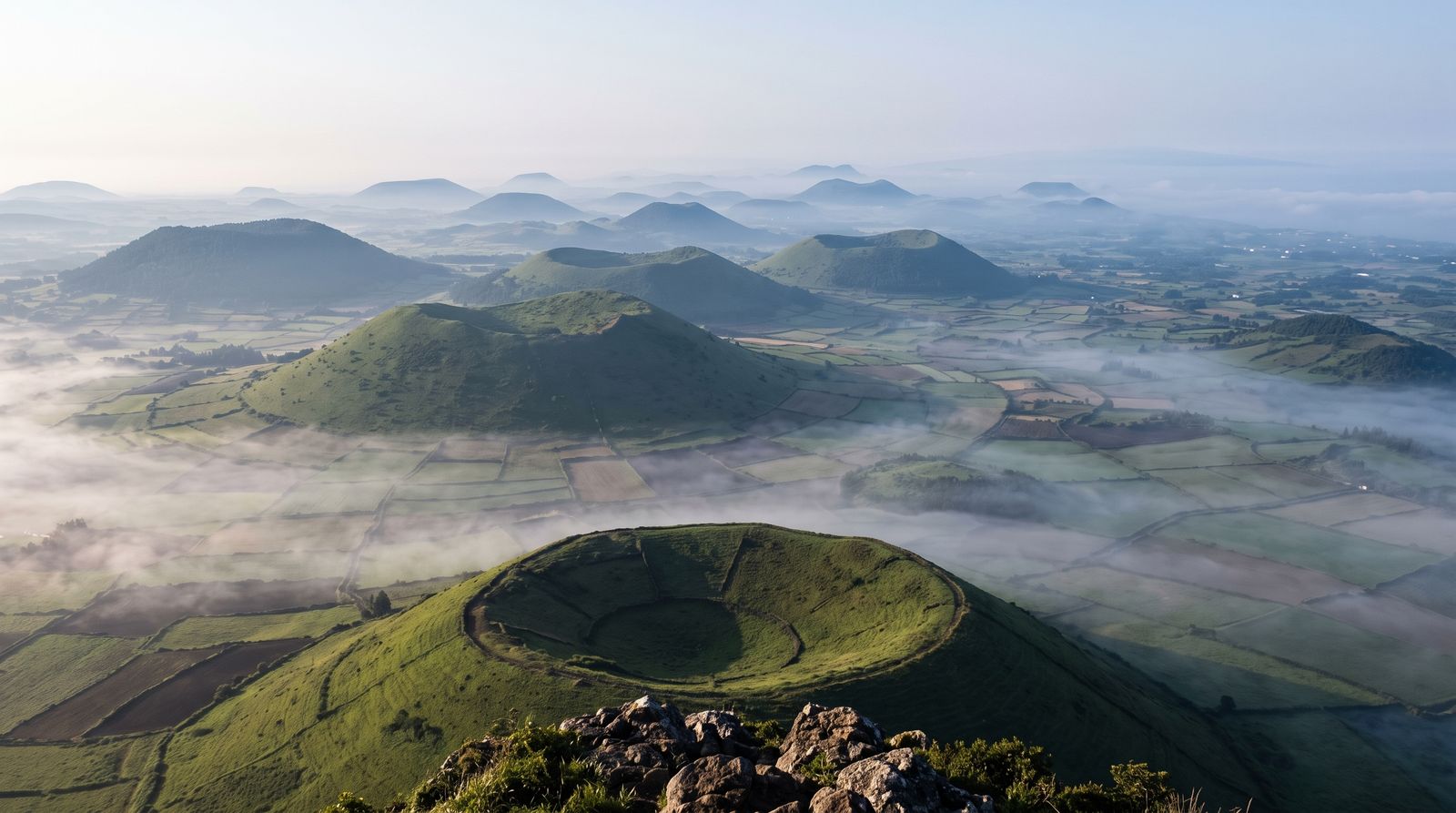
They are dormant, they are UNESCO listed, they run in a line for about thirty kilometres, and you can be standing on top of one an hour after leaving the city.
Ask a British traveller to name a volcano in Europe and you will get Etna, Vesuvius, possibly Stromboli, eventually Iceland. Nobody says France.
France has around eighty of them, in a row, in the middle of the country. They are dormant — the most recent activity was several thousand years ago — and they sit immediately west of Clermont-Ferrand in a line running roughly north to south. In 2018 the chain and the fault system beside it were inscribed as a UNESCO World Heritage site.
The whole thing is walkable, which is the part that makes it a holiday rather than a fact.
What you are actually looking at
A volcanic field rather than a single mountain. Each cone erupted once, built itself, and stopped — which is why there are so many of them and why they are all roughly the same modest size rather than one enormous peak.
The shapes vary in a way that becomes addictive once you notice it. Some are neat cones with a crater in the top. Some are cratères égueulés, where one side of the crater wall failed during the eruption and a lava flow poured out, leaving a horseshoe open to one side. Some are lava domes with no crater at all, built from material too thick to flow.
Standing on one and looking along the line at the others is genuinely one of the more remarkable views in Europe, and there is a reasonable chance you will have it to yourself on a weekday.
The one everyone climbs, and the one to climb instead
The highest is the Puy de Dôme, at around 1,465 metres. It has a rack railway to the top, a summit weather station and telecommunications infrastructure, and the remains of a Roman temple to Mercury, which tells you the summit has mattered to people for a very long time.
It is worth going up, and it is the busiest thing in the region by a considerable margin.
The Puy de Pariou is the better walk. It is close by, it has a textbook crater you can walk down into and around the rim of, and reaching it requires an hour or so on foot through beech woods with no railway option. If you do one, do this one. If you do two, do both, and do Pariou first while your legs are fresh and the light is good.
And a third, if you have the time
The paired cones of the Puy de la Vache and the Puy de Lassolas, towards the southern end of the chain, are the clearest breached craters in the field. The red scoria underfoot and the lava flow running away downhill make the mechanics of what happened here obvious in a way that a neat cone does not.
Walking the whole chain
There is a long-distance route running the length of the field, and doing it end to end over several days is a genuinely good walking holiday that almost no British walker does. Villages along the way provide the logistics, and the daily distances are moderate because the chain is only about thirty kilometres long.
It is not remote, it is not technically difficult, and it is not high. What it is is unusual, and unusual is rarer than difficult.
Base yourself in the city
Clermont-Ferrand sits at the foot of the chain and is a better base than anywhere in the hills. It is a real working city with a black volcanic-stone cathedral built from the local rock, which is a satisfying thing to see after a day spent walking on the material it came from.
From the UK it is usually reached via Paris or Lyon, then rail or a drive. It is not a hard journey and it is much less travelled than it should be.
THE WEATHER IS THE VARIABLE
The chain sits high enough and exposed enough that conditions on top differ substantially from conditions in the city below. Cloud sits on the summits a good deal of the time, and the view along the line — which is the entire reason to be up there — disappears completely when it does.
Check the forecast for the summits rather than for Clermont-Ferrand, and be prepared to reorder your days. A clear morning is worth rearranging a week for.
When to go
Late spring through to October. The beech woods on the lower slopes are worth the trip on their own in autumn. Winter brings snow and the walking becomes a different, colder proposition, though the cones under snow are striking.
Staying connected, honestly
This is not a wilderness. You are within sight of a city for most of it, and signal is generally reliable across the field — which makes the Chaine des Puys unusual among good walking areas.
The practical point is not coverage but weather. Download the forecast and your route in the morning rather than assuming you will check them from the top, because the useful decision — whether the cloud is lifting or settling — is one you make while walking up, often with cold hands and a phone you would rather not take out.
What else is nearby
The volcanic theme continues south into higher, older and wilder country, and the region is full of Romanesque churches built in the same dark stone. If you have a week rather than a long weekend, the chain is the beginning of it rather than the whole thing.
A short list for the walking days
A wind layer, whatever the forecast says. The summits are exposed and the temperature drop from the city is real.
The forecast downloaded in the morning, because the decision you are making all day is a weather decision.
Boots for the scoria. The volcanic gravel on some cones is loose and unkind to soft soles.
A working data connection, which here you can actually rely on — the chain sits beside a city and coverage across it is good. If you are coming from the UK, sorting out a travel eSIM or checking your roaming terms before you fly means the forecast is a two-second check rather than a decision made on guesswork.
Before you go
Late spring to October is the season, and autumn in the beech woods on the lower slopes is worth the trip by itself. Winter brings snow, the walking becomes a colder and more committing proposition, and the cones under snow are genuinely striking if you are equipped for it.
If you only have a day, do the Puy de Pariou rather than the Puy de Dôme — crater, no railway, an hour through beech woods to get there. If you have two, do both, and do Pariou first while the light is good and your legs are fresh.
And if you are thinking about the whole chain end to end: it is around thirty kilometres, the daily distances are moderate, it is not high and it is not technically difficult. What it is is unusual, and unusual is rarer than difficult.